A tree may need removing if it has large dead branches, fungus at the base, trunk cracks or cavities, a sudden new lean, storm damage, canopy dieback, or roots lifting paths and drains. One sign alone does not always mean removal, so have a certified arborist assess the whole tree before deciding.
Most trees never need removing, but knowing the difference protects your property and the people near it. Tree work is high-risk, and the right call is not always obvious from the ground.
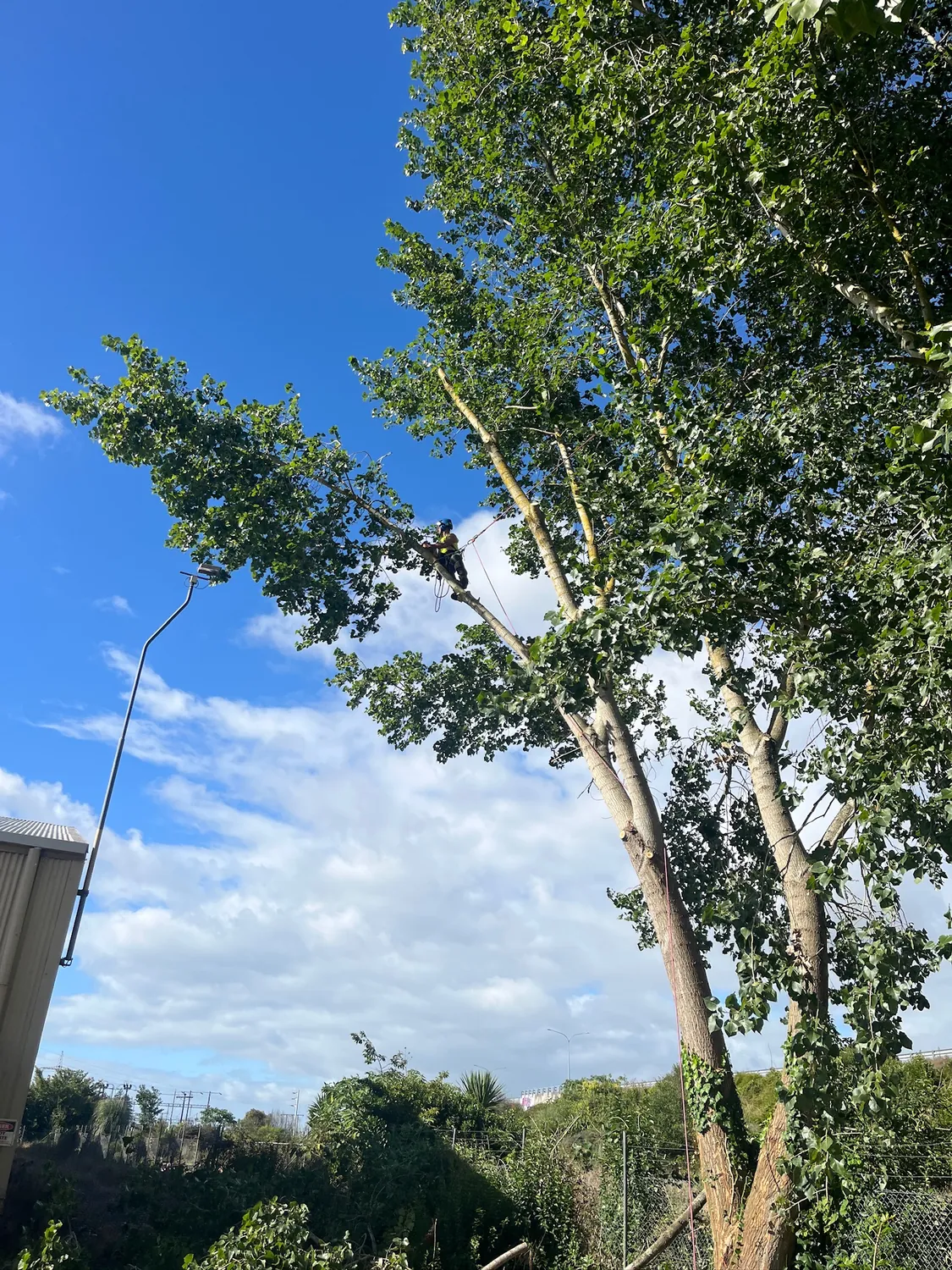
7 warning signs your tree may need removing
Walk around your tree and look at it properly, from the base to the top. These are the signs we watch for when we assess a tree in Hamilton and the Waikato.
1. Large dead branches and deadwood
A few dead twigs are normal. Large dead branches high in the canopy are not. Heavy deadwood can drop without warning and cause real damage or injury, especially over a house, driveway or footpath. Widespread deadwood also tells you the tree is struggling. Sometimes the answer is a prune to remove the dead limbs rather than the whole tree.
2. Fungal growth or bracket fungi at the base
Mushrooms or hard bracket fungi growing on the trunk or around the roots are a warning sign. They often mean decay is already at work inside the wood, and rot at the base can weaken the tree's anchorage where you cannot see it. Fungi do not always mean the tree is doomed, but they are a strong reason to get it looked at.
3. Cracks, cavities or included bark
Vertical cracks in the trunk, open cavities, or a large hollow can point to structural weakness. So can "included bark", where two stems grow tightly together with bark trapped in the join, creating a weak union that can split. A tree with a serious defect in the main stem or a major fork is a genuine concern.
4. A significant new lean or lifting roots
Most trees lean a little, and a long-standing lean is usually fine. A sudden new lean is not. If the ground on one side is heaving, or roots are lifting out of the soil, the tree may be starting to fail at the root plate. That is one of the more urgent signs and should be checked quickly.
5. Storm damage
The Waikato gets its share of wind and storms. After a big blow, look for split limbs, a partly uprooted trunk, hung-up broken branches, or a tree that has shifted. Storm-damaged trees can be unpredictable and are often best assessed before you go anywhere near them.
6. Dieback or disease across the canopy
If large sections of the canopy are thinning, browning or bare when they should be in leaf, the tree may be in decline. Progressive dieback across the whole crown, rather than one branch, suggests a wider health or root problem. Whether that means removal or treatment depends on the cause and how far it has gone.
7. Roots damaging foundations, paths or drains
Roots that are cracking a driveway, lifting paving, or getting into drains cause slow, expensive damage. Removal is not automatic here, and sometimes the problem can be managed, but a tree that keeps damaging built structures is often on the list to come out.
Does every warning sign mean removal?
No, and this is the important part. Many of these signs can be resolved without losing the tree. Deadwood can be pruned out. A minor defect can be monitored. A one-sided canopy can sometimes be reduced. The decision between saving and removing a tree is exactly what a proper assessment is for, and it is worth reading our guide to tree pruning versus tree removal before you assume the worst.
| Sign | Often fixable by pruning or monitoring | Points towards removal |
|---|---|---|
| A few dead branches | Yes, deadwood out | Only if widespread |
| Bracket fungi at the base | Sometimes, needs assessment | If decay is advanced |
| Sudden lean or lifting roots | Rarely | Usually, and urgently |
| Whole-canopy dieback | Depends on the cause | If the tree is failing |
| Major trunk crack or cavity | Sometimes monitored | If the stem is unsound |
Why get a certified arborist to assess it?
From the ground it is easy to miss the signs that matter and easy to panic over ones that do not. A certified arborist reads the whole tree, its species, its defects and its setting, and tells you honestly whether it needs work, watching, or removing. It is also genuinely dangerous work. As WorkSafe sets out in its health and safety guidance for arboriculture, tree work involves chainsaws, working at height and heavy limbs, which is why assessing and removing hazardous trees is skilled work best left to trained professionals rather than tackled from a ladder.
If a tree is clearly unstable, leaning further, or dropping limbs, treat it as urgent and keep people and cars away from underneath until it has been looked at.
Frequently asked questions
01Is a leaning tree always dangerous?
Not always. A tree that has grown at a lean and stayed that way for years is often stable. What matters is a new or increasing lean, especially with soil heaving or roots lifting, which can mean the tree is starting to fail. A quick assessment will tell you which one you have.
02Do mushrooms on my tree mean it is dying?
Not necessarily, but they are worth taking seriously. Bracket fungi and mushrooms on the trunk or roots often signal internal decay that weakens the wood. The tree may still stand for years, or it may be structurally compromised, so it is best checked by an arborist.
03My tree looks fine but its roots are cracking the drive. Should it go?
Maybe. Root damage to paths, drives and drains is a common reason for removal, but not the only option, and it depends on the tree, its value and how bad the damage is. We can assess whether it can be managed or is better removed, and price the removal and any stump grinding if it comes to that.
04How urgent is it after a storm?
If a tree is split, part-uprooted or has hung-up broken branches, treat it as urgent and stay clear of the area beneath it. Storm-damaged trees are unstable and hard to read, so it is safer to have them assessed before anyone approaches.
Not sure whether your tree is a worry or nothing to lose sleep over? An expert eye settles it quickly. If cost is on your mind, our guide to what tree removal costs in Hamilton and the Waikato explains what goes into a price.
If a tree on your property is showing any of these warning signs, we will assess it properly and tell you straight whether it needs pruning, monitoring or removing.
Talk to our certified arborists or get in touch for a free quote, or call 021 024 76217.
About Woodney Contracting. Family-run arborists, fencing contractors and earthworks operators serving Hamilton, Cambridge and the greater Waikato for 5 years. Fully insured, rated 5.0 from 14 Google reviews. Get in touch or call 021 024 76217.